
Why your tactics aren’t improving
The 4 fixes that can help you become a tacticianMost players think they’ll get better at tactics by doing more puzzles.
But if that were true, anyone with a 100-day puzzle streak would crush tactics in real games.
If you’re good at puzzles but miss tactics when you play, you’re probably training the wrong things, and in the wrong order.
In this post I’ll talk about 4 things I learnt as a player and coach that actually help you get better at tactics. You’ll learn what to train for your rating level and how to spot the real problems in your own games so you can finally find the tactics when they matter.
Let’s start with something almost no one talks about.
1. Become a tactician
Most players see tactics as a chore, something you just have to do. But good tactics aren’t just a skill. They’re part of your identity as a chess player.
There’s a book that explains this really well: How to Become a Deadly Chess Tactician by David LeMoir.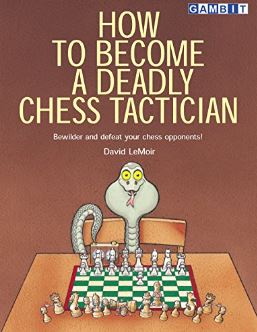
It’s a relatively old book (2002), but I read it many times. It teaches that being a tactician is something you grow into, not just about the skill. It’s a mindset, a way of seeing the board and enjoying the moments where you can go for something sharp or play a sacrifice.
At the amateur level, most games are decided by tactics. If you can spot more tactics than your opponent, and spot them faster, you win more games. It’s the foundation of your chess, just like you need to know how to kick the ball cleanly in soccer. Everything else comes after.
I had terrible openings and poor positional understanding as a junior, but because I loved tactics, even in worse positions, I always felt like I still had a chance. You just need to find one tactic your opponent missed, and you can win the game. This rule applies even when you’re playing against a grandmaster (see if you can find something for White in this position).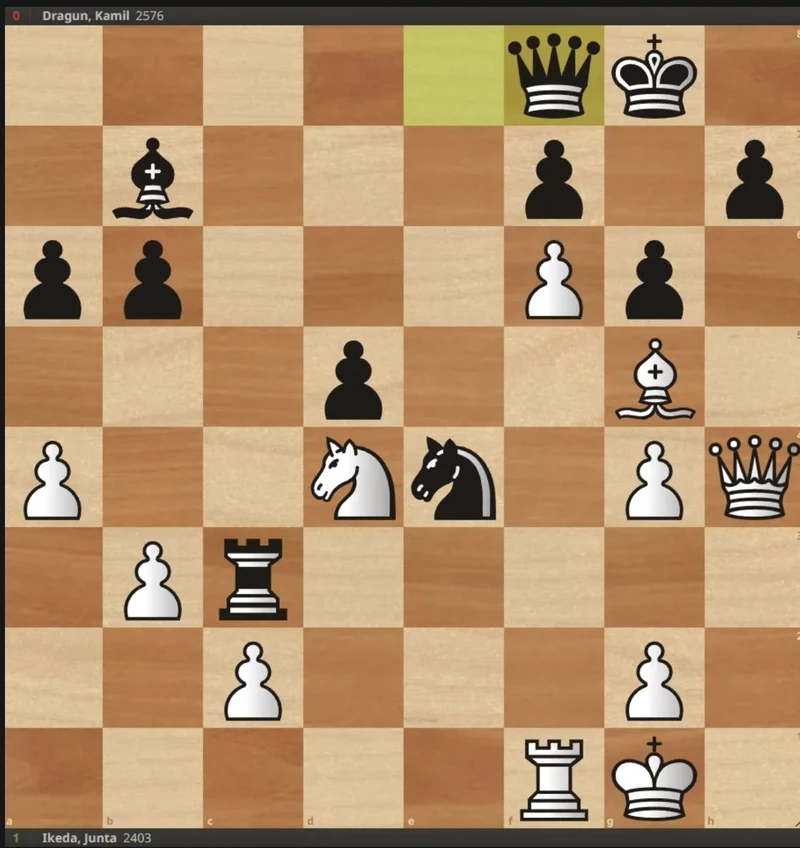
One game I remember is when I was maybe 9 years old. I was a small kid, I think I was the shortest in my grade at school including girls. I was playing a classical game against a big guy, probably 3 times my weight and I managed to do the classic smothered mate in the middlegame by sacrificing my queen. He got so flustered that his hand shook and he spilled his cup of coffee all over the board. I felt bad for him, but the feeling of executing that textbook tactic in a tournament game stayed with me.
Once you start seeing yourself as someone who likes this part of the game, not someone who’s “bad at tactics”, training gets easier. To keep improving, you’ll need to solve a lot of tactics, but here’s a small habit that helps right away. Whenever something changes in the position and you notice a loose piece, an open file or an exposed king, pause for a second and ask: “Is there a tactic here?”
Pausing in that moment is your first step in thinking like a tactician.
2. Train what’s important at your rating level
Now let’s talk about what really matters at your rating level, because this is where a lot of players waste time by working on things that aren’t helping.
If you’re under 500 online, your main job is to stop hanging pieces and grab free material when it’s there. You’re learning checkmates and the basic habits that stop you losing in one move.
From about 500 to 1000, you learn the simple one-move ideas like forks, pins and discovered checks. The themed puzzles on Lichess are great here. You’re teaching your brain the fundamentals so your eye wakes up when something tactical is happening.
From 1000 to 1500, you want to spot the tactics that take 2 or 3 moves. You start feeling the power of checks, captures and threats more and more. You want to keep cutting down on the simple blunders and solving lots of puzzles so you recognise more patterns. Around this level I solved a lot of tactics from CT-ART and books, and it helped a lot.
Between about 1500 and 2000, you’re still building your pattern base, but your exercises need to get harder. You want to get better at finding tactics even when you don’t have much time, and start working on your calculation. ChessTempo is great for this, and so are good puzzle books. These are a few I used myself (another recommendation: John Nunn’s Chess Puzzle Book).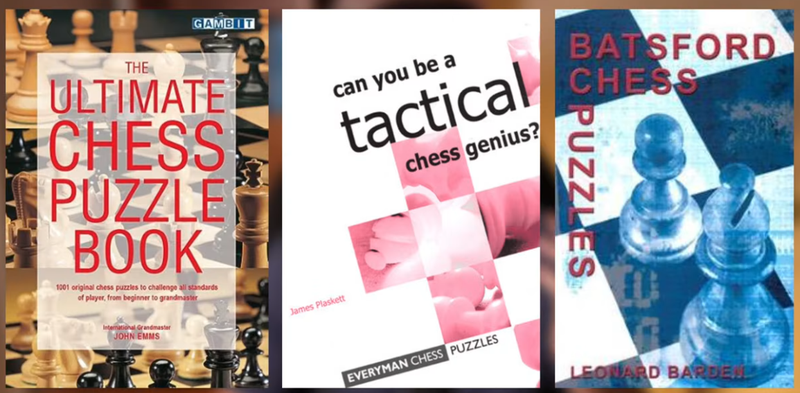
Once you’re above 2000, the focus shifts again. You start spotting your opponent’s tactics before they have a chance to play them. You can see longer combinations, and the accuracy of your calculation becomes key, because by now you already know most of the common patterns. You’re training how to think deeper and combine all the patterns you’ve absorbed.
By the time you’re around 2500, you spot ideas quickly. Most of your improvement comes from training the more complex calculation and being more critical in your thinking. These are a few of the calculation books I used (for 2000+ FIDE, I recommend Studies for Practical Players (Dvoretsky & Pervakov)).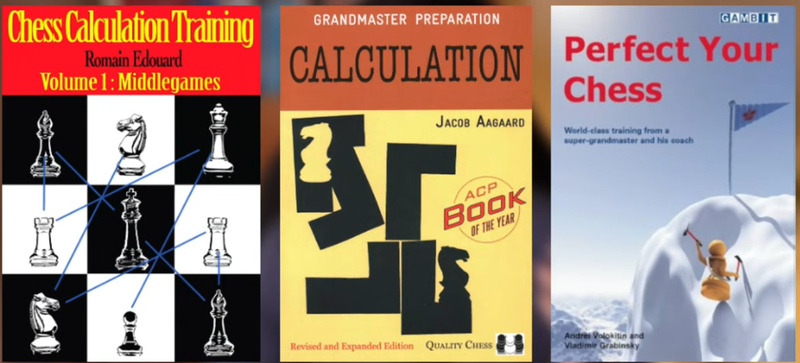
Rating gives you a rough idea of what to train at each stage, but it can’t tell you exactly what your issue is. That’s the next fix: letting your own games show you what you need to work on.
3. Diagnose your needs from your games
This is the part most players skip. It’s always easier to do a quick run of Puzzle Rush and feel that sweet dopamine than to look at a game you lost and ask, “What actually went wrong here?”
But this is where the real answers are. No two players have the same gaps in their chess:
- some need to learn more patterns,
- some need to find them faster,
- others need wider calculation,
- deeper calculation
- or just higher accuracy.
These are all very different problems, even though people put them all under one umbrella, “tactics”. And this is why solving random puzzles often isn’t enough. You’re not working on the area you should be.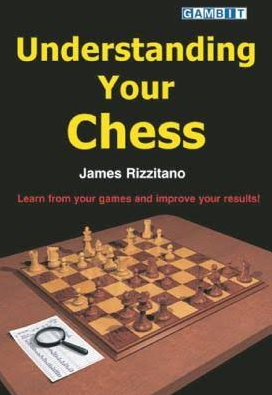 If you miss your own chances as well as your opponent’s threats, that’s a recognition problem. Your eyes aren’t picking up the patterns early enough. In that case, solve lots of simple and medium-level puzzles, and pay more attention to what your opponent wants to do.
If you usually see the idea but mess up the details, that’s not recognition anymore, but calculation. You need slower and deeper work. Work on harder exercises, give yourself at least ten minutes, write your lines down, and really try your best. Using a real board helps because you can’t cheat, you avoid distractions, and the thinking feels like over the board chess.
If you play over the board, look at your classical games from the past year. For example, you might be good at finding tactics from your side, but miss your opponent’s forcing moves.
In my case, I have a good eye for tactics, but when it comes to calculation, going deep on complex variations and evaluating them, I struggled for a lot of my chess life. I think I just didn’t want to acknowledge that I had this weakness and I wanted to avoid that hard work, but I wish I hadn’t done so for so many years, it really held me back.
So if you’re reading this, please take the time to find your issues, and don’t run away from them. If you’re serious about long-term improvement, this is something you just have to face up to, and the earlier the better.
If you mostly play online, your rapid and blitz games tend to tell you different things. Maybe in blitz, you miss tactics from the opening, while in rapid you often fall apart in endgames because you don’t have time to calculate. Train the part of the game where the problems keep showing up, because for the parts you’re already doing well, they don’t take as much effort.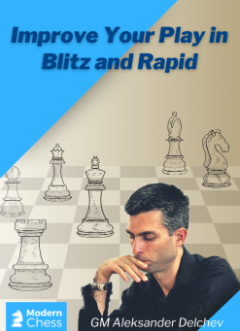 Here’s a simple tip that helps a lot of players. If you’re blundering almost every blitz game, don’t try to fix it by playing more blitz. Play more rapid games first. Speed comes after accuracy, not before.
So once you’ve looked at your games and worked out whether you’re missing ideas or miscalculating them, you’ve found the root cause. And underneath every success and failure in tactics, yours, mine, anyone’s, there are really only two skills at work.
One is fast, and one is slow.
4. Learning how to think fast and slow
Now that you have a better idea of what you should work on for your chess, let’s zoom out and look at what tactics really are through these two core skills.
The fast skill is pattern recognition. It’s that instant feeling you get that there’s something in this position. Your brain says, “Wait... I’ve seen this before.”
The slow skill is calculation. This is where you stop and check if your idea actually works. You go move by move, line by line, without guessing.
A psychologist named Daniel Kahneman called these two ways of thinking System 1 and System 2. In chess, System 1 is your instinct. It tells you something might be there.
System 2 is your careful thinking. It tells you what’s there, and whether it really works. You need both to play well.
You can improve your pattern recognition by solving a lot. The more reps you put in, the better your instinct becomes. Let’s call it quantity training. Masters have solved thousands, tens of thousands of tactics.
Your calculation gets better with slow, honest work. You work on harder positions, write down your lines, and don’t count a puzzle as solved if you missed something important. Let’s call it quality training.
For calculation, a good rule is to choose exercises you can solve about 70% of the time with real effort. If they’re too easy, you don’t learn, and if they’re too hard, you burn out.
And remember, you don’t learn patterns only from puzzles. You learn them from
- your own games,
- looking at your mistakes,
- studying games and
- playing through classics.
The more places you learn from, and the higher their quality, the stronger your instinct gets.
Knowing how tactics work in your brain is great... but none of it matters unless you can execute it in your games. This is where everything we’ve talked about comes together.
The goal: finding tactics in your games
If there’s one thing I want you to remember from this post, it’s that the goal isn’t to be good at puzzles. The goal is to get better at finding tactics in your actual games, when your palms are sweaty, the clock is running and pieces are everywhere. That’s what your training’s for.
Your pattern recognition training should be quick and often, and your calculation training should be slow and challenging.
And consistency always beats intensity. If you can train every day, great. If not, a few days a week still works really well. Sometimes you go through a phase where solving tactics feels like a fun game, and you rack up thousands of puzzles. Honestly, that can help a lot because you’re so into it. But it’s hard to keep that up forever, so what you want is a habit you can stick to without burning out.
If you have someone to train with or talk tactics with, that’s always good, as well as having a coach who can guide you in the right direction.
Summary
So, this is one way to improve your tactics that’s worked for me and students I’ve taught.
- you add a layer to your identity
- you train what matters at your rating level
- you find the gaps in your tactics from your own games, and
- you work on both your fast and slow thinking.
When these four things line up, your tactics won’t just be better in puzzles. They’ll start showing up in your real games.
And that is how... you become a real tactician.
Real life is, to most men, a long second-best, a perpetual compromise between the ideal and the possible; but the world of pure reason knows no compromise, no practical limitations ...
—Bertrand Russell, The Study of Mathematics
What’s helped you with tactics in your chess life?
You may also like
 thibault
How I started building Lichess
I get this question sometimes. How did you decide to make a chess server? The truth is, I didn't. IM datajunkie
The 5 things I do before a tournament
Learnt from 25 consecutive years of OTB IM datajunkie
#33: My Most Memorable Novelty
The joy of charting unexplored territory ChessMonitor_Stats
Where do Grandmasters play Chess? - Lichess vs. Chess.com
This is the first large-scale analysis of Grandmaster activity across Chess.com and Lichess from 200… IM datajunkie
25 lessons from 25 years of chess
Mistakes you can avoid and habits you can start with today GM Avetik_ChessMood